Side project
Turning a scattered-prompt problem into a full-stack AI product experiment
I built Pasta to test whether people needed a model-agnostic home for prompts and to learn the systems behind modern AI products. Over a year, it grew from a simple prototype into a markdown workspace with authentication, Supabase, inline AI streaming, and an assistant that could edit the canvas directly.
- Timeline
- 2024-2025
- Role
- Creator & Developer
- Scope
- Product Strategy, UX/UI Design, AI Agent Design, Full-stack Development, Product Management
Overview
At the end of 2024, browser-based coding agents were beginning to make working software accessible to people outside traditional engineering roles. Lovable and v0 were entering the market, and among the tools I evaluated, Databutton was the first to give me both Google authentication and a Supabase integration out of the box.
I used that opening to pursue two questions at once: whether a model-agnostic prompt workspace could solve a recurring user problem, and how far I could take a product by learning the technical systems behind it. What began as a small prompt-library prototype became a year-long product and engineering project.
Problem
Prompts rarely stays inside a single model. People move among ChatGPT, Claude, Gemini, and specialized tools as they compare outputs, refine instructions, and build automations. That experimentation is useful, but it scatters prompts across chats, documents, notes, and product-specific histories.
The result is a fragmented workflow. Prompts are difficult to find, compare, reuse, and share. Their history and rationale disappear through copy and paste, and what should become a durable library remains tied to whichever model or tool happened to be used last.
Product hypothesis
A model-agnostic workspace could become the source of truth for prompt work, helping people move from early exploration to reusable, production-ready prompts without losing context along the way.
Context & Role
I initiated and led Pasta as a side project, owning the product direction, interaction design, prototyping, and delivery. I also used it as a deliberate technical apprenticeship: learning authentication, data modeling and backend infrastructure with Supabase, deployment with Vercel, editor serialization, AI streaming, and the integrations required to operate a real product.
As the scope grew, I worked directly with members of the Plate.js team on the editor foundation and managed two offshore developers. I remained responsible for defining the product model, resolving interaction and technical tradeoffs, and maintaining quality across the experience.
What I set out to learn
- Whether the prompt-management problem extended beyond my own workflow
- How authentication, backend infrastructure, and deployment fit together in a production application
- How an AI assistant should behave inside a rich-text editor, not beside it
- How to direct implementation and make product decisions across a small, distributed team
Development
Databutton made the first prototype possible, but its visual and interaction output did not meet the standard I wanted for the product. I experimented with several development environments before moving to VS Code with Cline and Figma’s experimental MCP server. That workflow let me connect design intent to implementation more directly while building my own fluency in the codebase.
The product evolved from a simple library with no markdown support into a full writing and prompt-engineering environment. The hardest work was not an isolated screen. It was designing a coherent system across editor state, markdown serialization, streaming AI responses, structured prompt metadata, and an assistant that could safely act on the document itself.
AI-assisted development
Coding agents accelerated implementation, but they did not determine the product. I defined the workflows, interaction model, and quality bar, then used Cline to implement, inspect, and debug against that direction. The process made generated code another design material that still required judgment, testing, and deliberate technical decisions.
From library to workspace
Each screen here answers a different half of the problem. The library and its tagging make prompts findable across models; the editor and its variables make a prompt something that is reusable rather than something you copy, paste and edit by hand every time.
Building the editor
The editor became the center of the product. Working with Plate.js gave me a deeper understanding of rich-text architecture, including how editor state is serialized, how markdown moves into and out of the system, and how AI output can stream inline without disrupting the user’s workflow.
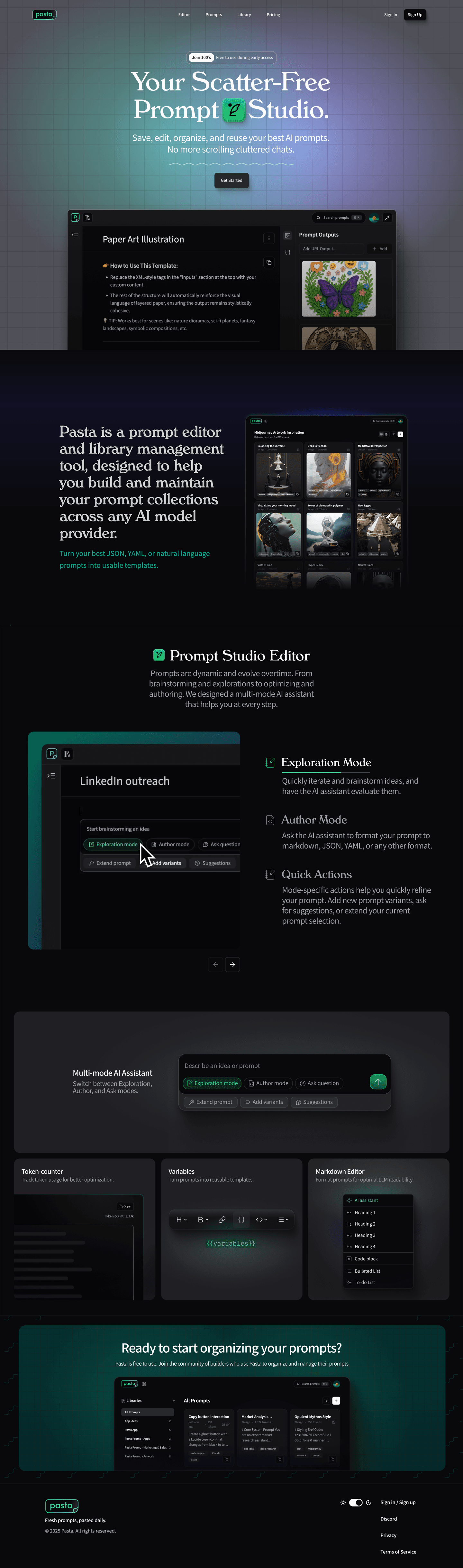
I designed a multi-mode assistant to support different stages of prompt development. Users could explore an early idea, refine its structure and constraints, then prepare it for repeated or production use. Instead of returning suggestions in a separate chat, the assistant could make targeted edits directly on the editor canvas while keeping the user in control of the document.
Technical scope
- Google authentication and account flows
- Supabase data models and backend infrastructure
- Vercel AI SDK, deployment and production configuration
- Rich-text editing and markdown serialization
- Inline AI streaming and direct canvas editing
- Prompt libraries, tags, sharing, and token-usage visibility
- Product email flows and third-party integrations
One assistant, three jobs
The modes adapt to each stage of prompt development. Exploration turns an early idea into working material, Authoring structures that material for a model to interpret, and Quick Actions surfaces repeatable actions on what the user selected. Each mode writes directly to the document and requires the user to accept or discard the result, keeping the workflow fluid while preserving the writer’s control of the canvas.
Delivery
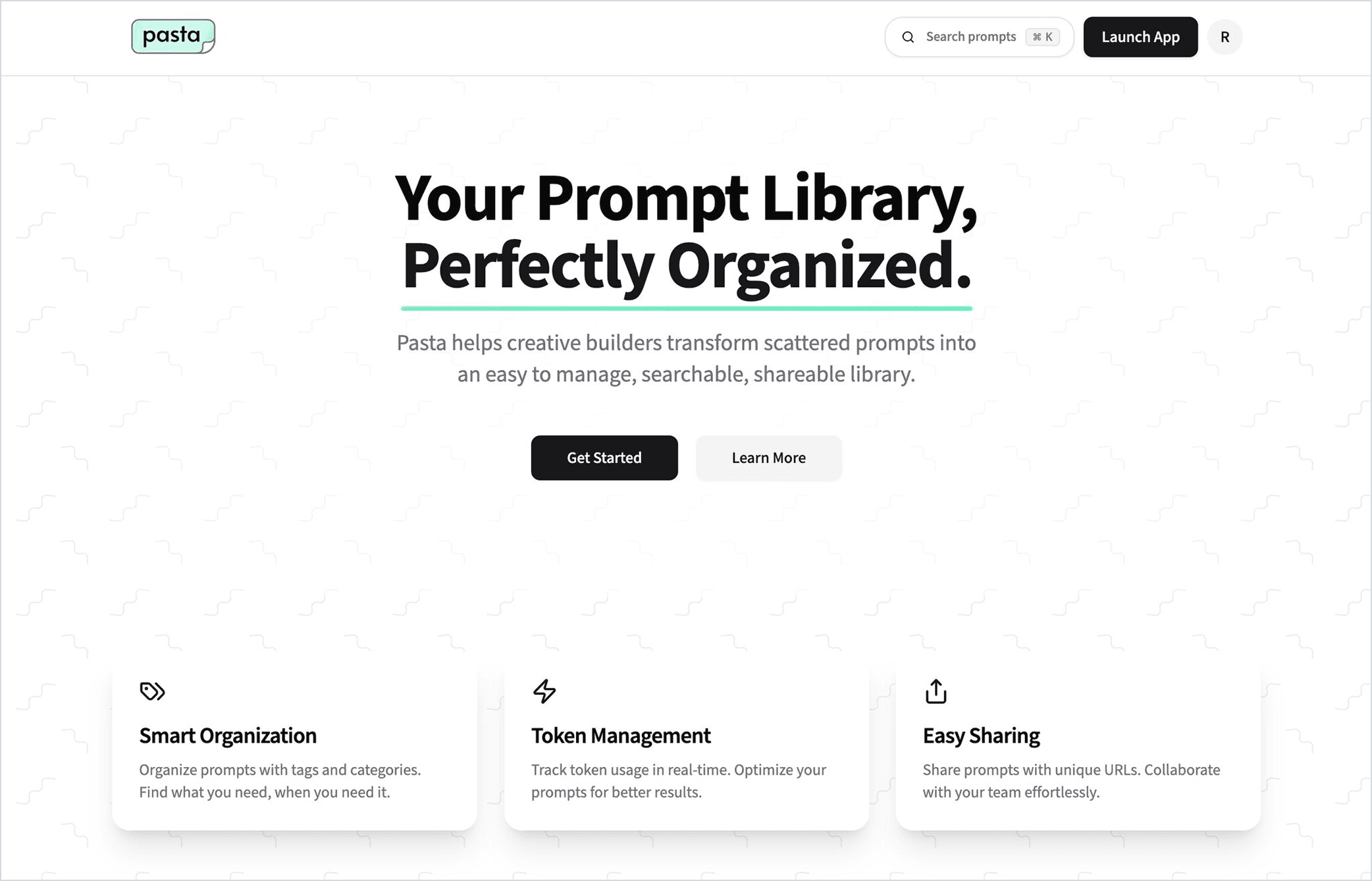
I shipped an opinionated prompt-management product that brought prompts, outputs, and supporting context into one workspace. Users could organize work through libraries and tags, track token usage, share prompts, and develop them inside a markdown-capable editor with a purpose-built AI assistant.
The most meaningful delivery was the distance between the first and final versions. Pasta moved from a constrained prototype into a deployed, end-to-end application with a custom editor experience, working infrastructure, and an interaction model that treated prompt engineering as a process rather than a single chat exchange.
Outcome
As a technical project, Pasta achieved what I set out to learn. I took a product from concept to production, developed fluency across the frontend, backend, deployment, and AI interaction layers, and learned how to collaborate with maintainers and developers on technically complex product behavior.
As a product, the result was more mixed. Pasta generated interest and curiosity, but that initial attention did not become sustained use over a longer horizon. The product demonstrated that the experience could be built; it did not prove that prompt management was a strong enough recurring need to become a lasting habit.
Learning
The most important lesson was not about serialization, authentication, or AI streaming. I invested heavily in proving the solution before establishing how often the problem occurred, what repeat behavior would indicate value, and whether users would return without being prompted by a new feature.
My own frustration was real, but it was not sufficient evidence of a durable market. Interest and curiosity were encouraging signals, not retention. By the time that distinction became clear, the technical ambition of the product had already outpaced the evidence supporting it.
I would approach the project differently now: define the repeat-use behavior and retention threshold first, test the smallest workflow that could produce that behavior, and expand the product only when those signals held. Pasta made me a more capable builder, but its most valuable outcome was sharper product judgment. Proving that I could build the system was different from proving that the system deserved to become a product.